
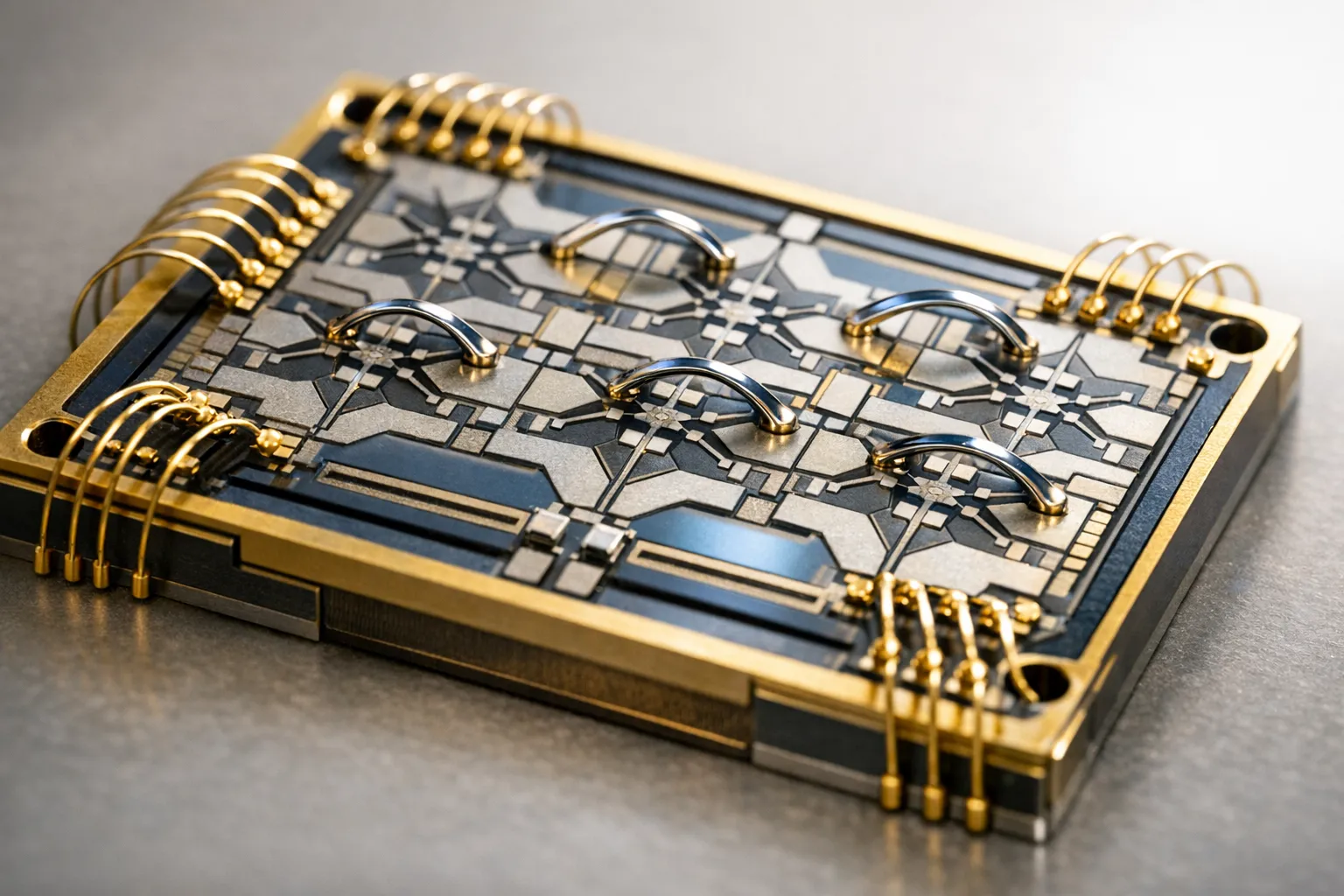
Three orders of magnitude is the kind of number that usually makes quantum engineers squint at the appendix. Yet barbell qLDPC codes showed up in the last weeks of June 2026 with exactly that claim: IQM Quantum Computers says these hardware-aware codes can drive logical error rates up to three orders of magnitude below the surface code while using up to eight times fewer physical qubits for comparable protection.
If that result survives contact with full-stack experiments, barbell qLDPC codes won’t just improve quantum error correction for superconducting architectures. They would reset the architectural default. I’d rather design around a code that respects wiring, couplers, and decoder latency than keep pretending the surface code is free because it’s familiar.
IQM’s pitch is unusually concrete. The barbell family comes from tile codes, runs on a six-qubit star lattice with near-local couplers, and uses superdense syndrome extraction to measure multiple stabilizers at the same time. This isn’t abstract coding theory hovering above the hardware stack. It’s a code proposal aimed straight at the ugly parts of superconducting machines: routing congestion, ancilla placement, readout fanout, control-channel density, and the classical decoding path that has to keep up in real time.
Why barbell qLDPC codes matter beyond coding theory
The surface code has dominated fault-tolerant roadmaps for more than a decade for good reasons. Local checks. Planar layouts. A large body of theory and experiment. But the engineering bill is brutal. Once you start projecting to a few hundred logical qubits, qubit overhead and routing complexity become the real design constraint, not the elegance of the decoding paper.
IQM’s press communications and arXiv paper go straight at that bottleneck. They describe barbell codes as qLDPC codes derived from tile codes, a translationally invariant family of two-dimensional local codes with flexible locality constraints. The practical claim matters most: by shaping stabilizers for a six-qubit star lattice and using near-local couplers only between X and Z stabilizers, the code keeps the hardware graph close to what a superconducting chip can actually support.
The reported numbers are hard to ignore. With fewer than 30 physical data qubits per logical qubit, a distance-14 barbell code reaches a per-round logical error rate of about 1.4 × 10⁻⁷ at a physical error threshold of 10-4. At a physical noise level of 10-3, a distance-11 barbell code using 400 data qubits produces a logical error rate of 8.8 × 10⁻⁷, nearly three orders of magnitude lower than 16 patches of a distance-5 surface code using the same physical qubit budget. A distance-8 barbell patch performing continuous logical ZZ measurement lands around 7.4 × 10⁻⁵ per round at a 0.09% physical noise floor, close to a baseline memory experiment error rate of 4.4 × 10⁻⁵ under the same conditions.
Those figures matter because most superconducting roadmaps for the late 2020s don’t assume endless qubit counts. They assume a few thousand reasonably good qubits, if everything goes well. A code that needs tens of thousands of physical qubits per logical qubit is fine for a roadmap slide and poor as an implementation target. This is the wrong default for near-term architecture planning.
Mapping barbell qLDPC codes onto a superconducting lattice
The six-qubit star lattice is where barbell stops being a generic qLDPC story and turns into a chip-design problem. Picture a repeating motif with a central qubit and surrounding neighbors arranged to keep entangling gates short, readout resonators accessible, and coupler routing bounded. The geometry isn’t fully planar in the strict surface-code sense, but that isn’t the goal. The near-local couplers add a controlled amount of non-planarity to relieve the worst routing pressure.
What the floorplan actually has to optimize
A realistic floorplan has to balance at least 4 things at once: qubit frequency allocation, coupler placement, resonator escape routing, and package-level I/O density. Surface-code layouts often hide the last two behind idealized nearest-neighbor diagrams. Barbell can’t. Its value comes from admitting the physical constraints and shaping the code around them.
Start with unit-cell replication. The star cell should tile in a way that keeps X and Z stabilizer ancillas spatially paired, because the near-local couplers are reserved for X-Z stabilizer connections. That’s clever. It narrows the routing problem and lowers the odds that every useful edge in the Tanner graph becomes another metal-layer crisis. You still need to budget for crossovers, via density, and resonator spacing, but at least the coupler graph isn’t unconstrained chaos.
Ancilla placement is the next pressure point. Superdense syndrome extraction works only if ancillas can be reused across multiple stabilizer measurements without creating a timing knot. In practice, that means placing readout resonators and Purcell filtering so measurement of one stabilizer group doesn’t starve a neighboring group of bandwidth or inject extra dephasing. Engineers building this on superconducting hardware will need to co-simulate microwave layout and syndrome schedule. If that work is split across teams with a PDF handoff, expect pain.
Superdense syndrome extraction is a routing strategy disguised as a circuit trick
IQM’s defining move is superdense syndrome extraction: multiple stabilizers are read out simultaneously through carefully choreographed entangling and measurement operations. The obvious benefit is lower circuit depth per syndrome round. The less obvious benefit is architectural. Shared ancilla resources can cut the number of dedicated measurement paths and reduce long detours that would otherwise clutter the chip.
Still, shared resources are never free. Correlated faults become the central concern. If one ancilla or coupler participates in several checks inside a dense extraction cycle, calibration drift or a spectator interaction can spread damage faster than a simple surface-code schedule would allow. I’d spend more effort on fault-set characterization here than chase one more percent of packing density. qLDPC codes live or die on whether their elegant check graph survives ugly hardware noise.
A prose system diagram helps. At the center sits a star-lattice patch of data qubits. Around each patch are paired X and Z stabilizer ancillas, linked by near-local couplers. Along the periphery run readout resonators grouped into multiplexed lanes. Above that, a control layer issues synchronized entangling pulses to stabilizer neighborhoods, then triggers batched measurements whose bitstreams are streamed off-chip to a decoder. The architecture is compact, but only if timing and routing were designed together from day one.
Control electronics for barbell qLDPC syndrome cycles
Barbell codes put pressure on the classical edge of the machine. Frequent stabilizer measurements, dense entangling schedules, and conditional follow-up operations don’t tolerate a sleepy control stack. Quantum Machines has been explicit about this in its writing on scalable quantum error correction: practical fault tolerance needs low-latency decoding, real-time feedback, and high-bandwidth control across hundreds of channels.
The OPX1000 matters here because its design target matches the syndrome workload. Quantum Machines describes it as offering the highest channel density in the industry, with up to 80 analog channels in a modular system scalable to multi-qubit experiments. The product argument is simple and correct: bring classical resources as close as possible to the qubits to eliminate latencies. Barbell-style superdense extraction is exactly the kind of workload that rewards that choice.
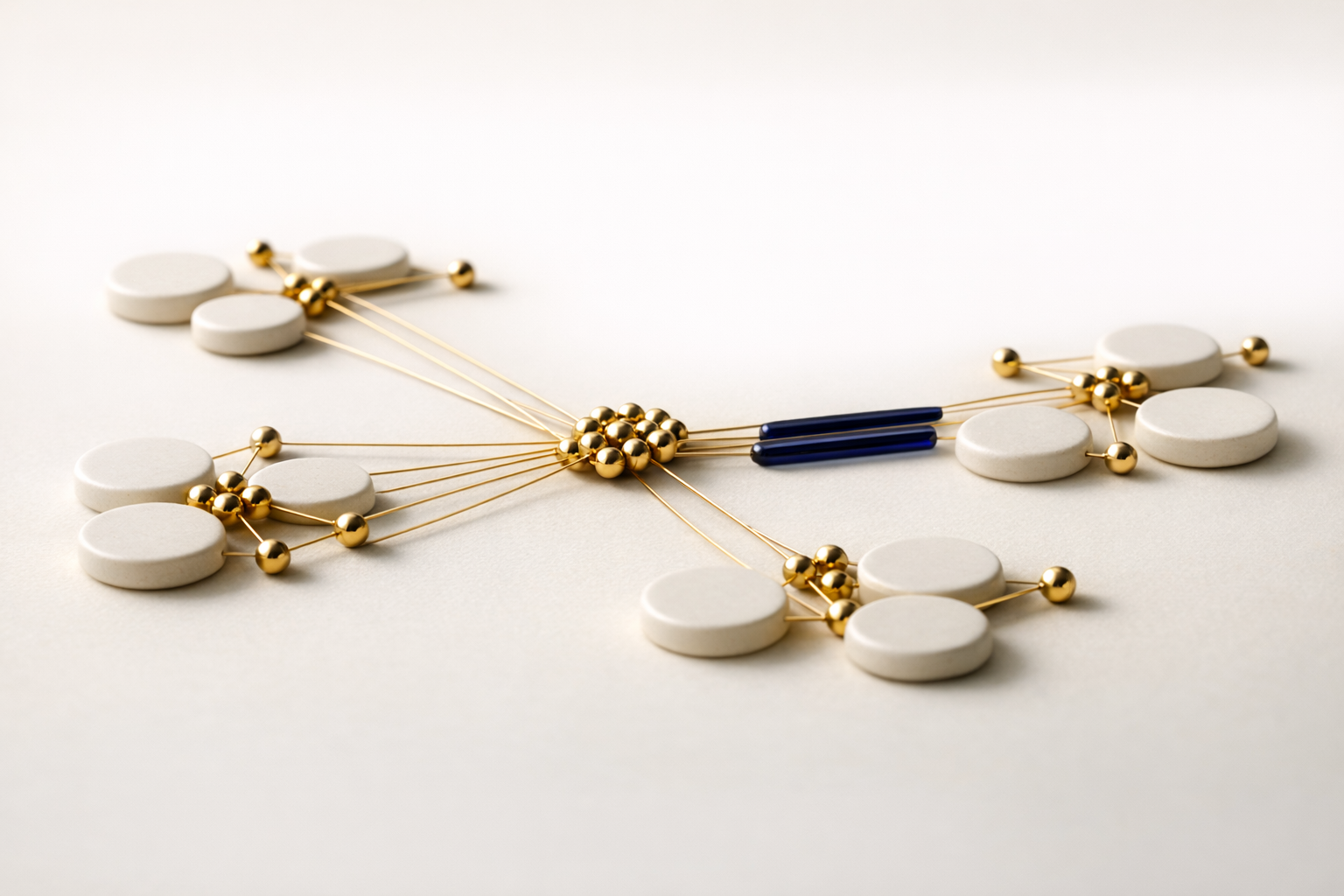
Dense, near-local interconnects evoke the parallel stabilizer readout that cuts routing complexity.
Timing budget before decoder latency starts to hurt
Think through a single syndrome round. You issue entangling gates over a stabilizer neighborhood, pause for measurement integration, discriminate the readout, package syndrome bits, hand them to a decoder, and possibly schedule conditional operations before coherence debt accumulates. Every stage has variance. Measurement integration windows aren’t perfectly identical. Readout collisions happen. A decoder queue spikes because one batch carried more ambiguous events than expected. If your architecture assumes zero slack, it’ll fail in a very ordinary way.
That is why hybrid quantum-classical supercomputer designs matter. Quantum Machines’ architecture blueprint places QPUs beside CPU and GPU clusters with tightly coupled networking for syndrome flow. This isn’t marketing garnish. For qLDPC codes with denser stabilizer graphs than the surface code, the handoff between control hardware and classical processing becomes part of the code design. Microsecond-scale response isn’t a nice-to-have.
// Simplified control-loop sketch for one barbell syndrome epoch
for epoch in syndrome_rounds:
    play(entangling_schedule[epoch])
    measure(stabilizer_ancillas, kernel="optimized_iq")
    bits = discriminate(raw_iq_stream)
    enqueue(decoder_ring, bits, timestamp=epoch)
    correction = decoder.poll_deadline(epoch)
    if correction.ready:
        play(frame_updates(correction.pauli_frame))
    log(metrics(bits, correction.latency, readout_snr))
The code sketch is deliberately plain. The point isn’t syntax. The point is architecture: pulse sequencing, readout discrimination, decoder enqueue, deadline-aware correction, and telemetry all sit in the same loop. Engineers who treat observability as optional at this stage are making a category error. When a qLDPC experiment degrades, you’ll need latency histograms, readout SNR drift, syndrome sparsity statistics, and per-ancilla fault rates, not just a single logical error number at the end of the run.
Decoding pipelines: where barbell qLDPC codes get expensive
Surface-code decoders have had years of optimization, from minimum-weight perfect matching implementations to hardware-friendly approximations. Barbell codes don’t get that luxury yet. Their stronger hardware efficiency comes with a decoder problem that is richer, denser, and less forgiving of lazy software design.
GPU, FPGA, or a split decoder
There isn’t a single right answer. GPU-accelerated decoders are attractive when the stabilizer graph is large and batch throughput matters more than single-event determinism. FPGA-based decoders win when fixed latency dominates and the syndrome-processing graph can be compiled into stable pipelines. A split design is often the pragmatic choice: FPGA or controller-side logic handles fast discrimination, compression, simple frame updates, and health checks, while GPUs process heavier inference on rolling windows of syndrome data. It’s fine for a prototype, not for a fleet, if you leave the split boundary vague.
Riverlane’s February 2026 end-to-end quantum error correction experiment at Oak Ridge National Laboratory is the practical reference point, even though it focused on a distance-3 surface code. The important result wasn’t merely that a surface code ran. It was that Riverlane’s Deltaflow technology demonstrated a complete path from physical operations through real-time syndrome extraction to classical decoding and correction under actual timing constraints. Barbell implementations will need the same discipline, just applied to more complex stabilizer graphs and tighter dataflow engineering.
Streaming architecture beats offline heroics
A barbell decoder pipeline should be designed as a streaming system, not a sequence of post-processing scripts pretending to be control software. Syndrome packets need monotonic timestamps, patch identifiers, ancilla health flags, and enough metadata to reconstruct a bad round without replaying the whole experiment. Store raw IQ for selected windows, not forever. Keep decoded Pauli-frame updates append-only. Build alerting around latency excursions, syndrome-distribution drift, and dropped-packet counts. These are boring software choices. They are also the difference between a publishable demo and six months of irreproducible lab folklore.
The wider industry supports this direction. AWS’s June 15, 2026 collaboration update with QuEra put fault-tolerant computing on Amazon Braket on a concrete timeline, with Libra targeted for 2028 as a Megaquop-scale machine capable of one million quantum operations over hundreds of logical qubits. AQT’s LYNX series reported a quantum volume of 32,768, showing what improved fidelity and connectivity can do in trapped ions. Different hardware, same lesson: once physical performance reaches a certain level, the bottleneck shifts toward error-correction architecture, control bandwidth, and decoder execution.
Where barbell codes fit in near-term fault tolerance
Surface codes still have the safer literature base and cleaner planar story. If your team needs the most mature decoder stack today, surface code remains the conservative choice. But conservative isn’t the same as efficient. For superconducting systems expected to live in the few-thousand-qubit regime, barbell codes look like a serious attempt to spend the qubit budget where it matters instead of burning it on overhead.
IQM’s broader milestone announcement says new codes from its research group can reduce qubit overhead by up to 1,000× compared to today’s leading approaches. The mapping from that headline number to specific barbell parameters isn’t fully unpacked in the marketing text, so engineers should stay disciplined and anchor decisions in the published code constructions and circuit-level simulations. Still, the direction is clear. Hardware-aware qLDPC design is no longer a speculative side project. It’s becoming the main event.
For European superconducting efforts, that matters a great deal. IQM’s approach lines up with an engineering-first view of quantum progress: code design, chip layout, control electronics, and decoder infrastructure developed as one stack. That’s the right instinct. I’d rather see one robust barbell prototype with honest latency accounting than ten more perfect simulations that quietly assume the wiring and control plane will sort themselves out later.
The concrete question engineers should ask next
The interesting question isn’t whether barbell qLDPC codes beat the surface code on paper. IQM has made that case strongly enough to earn serious attention. The narrower, tougher question is this: can a superconducting stack run superdense syndrome extraction, stream the resulting data through a low-latency decoder, and keep correlated faults below the point where the theoretical advantage evaporates?
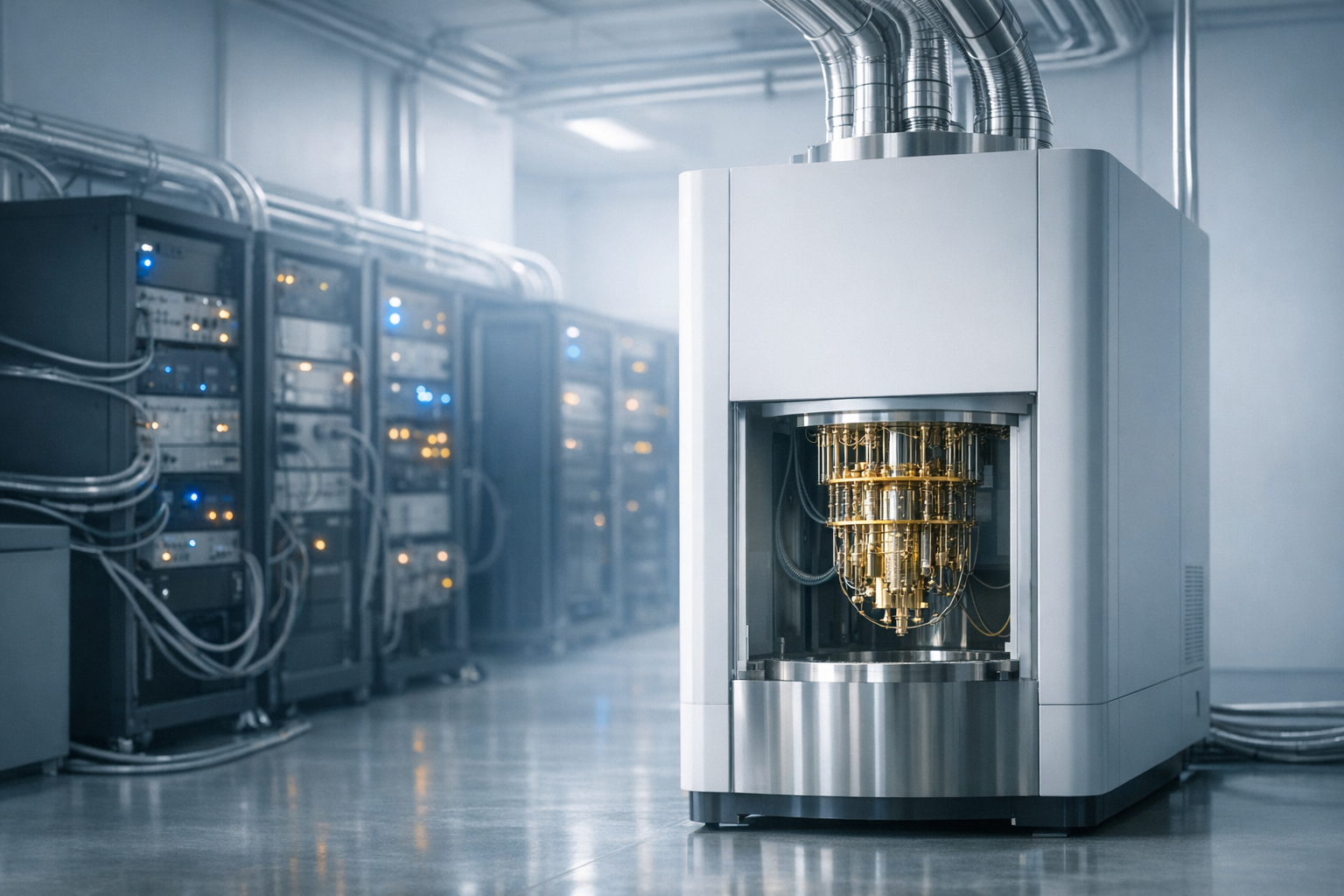
Fault tolerance depends as much on the surrounding control stack as on the code itself.
That experiment needs a real chip floorplan, a control system in the OPX1000 class, an end-to-end decoding path in the Deltaflow mold, and instrumentation good enough to catch failure before the logical qubit lies to you. When that stack exists, barbell won’t be a promising code family. It will be an architectural decision. If it doesn’t, then the surface code keeps its job for a very mundane reason: the plumbing won.